
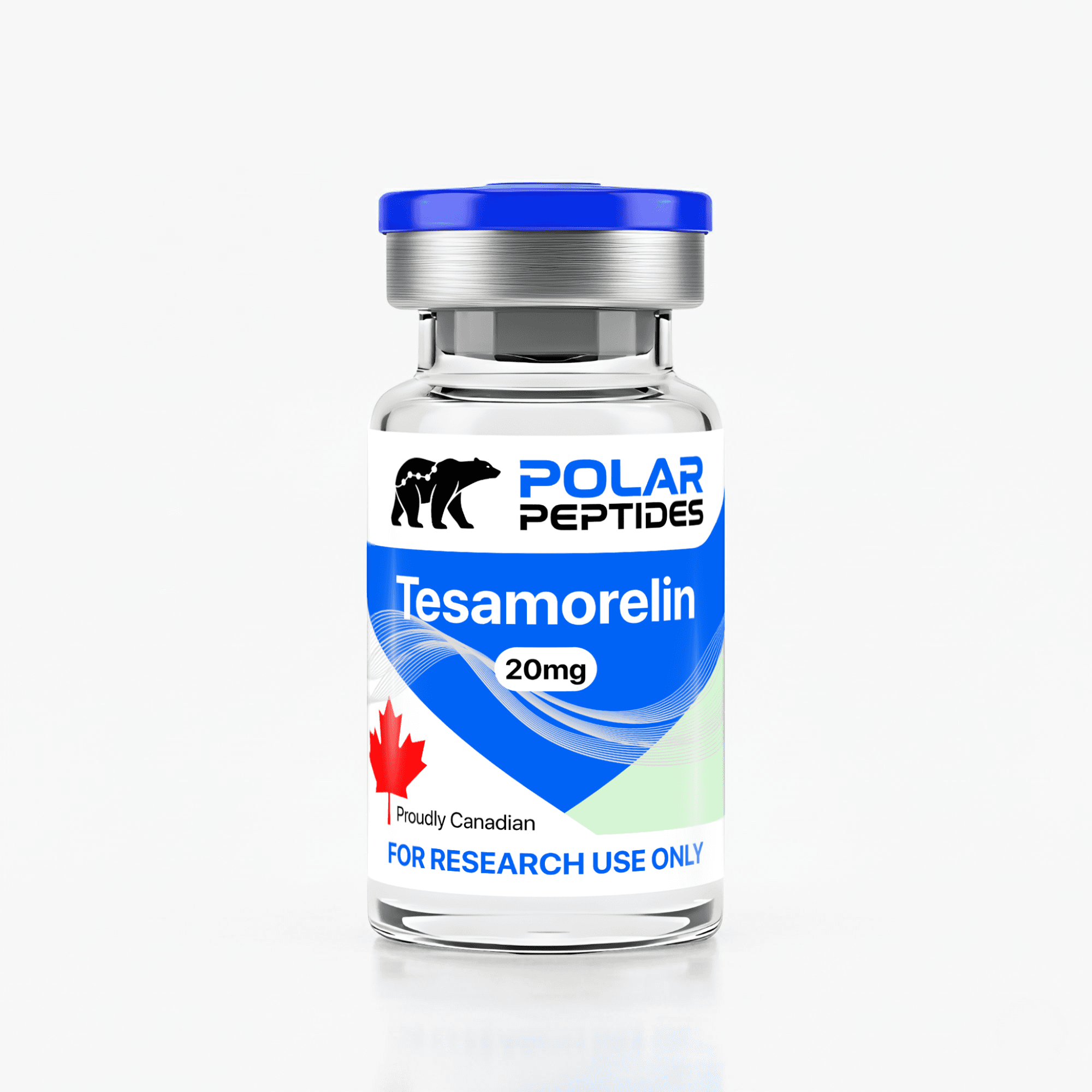
 99%+ purity
Tesamorelin
★★★★★4.9 — customer reviewsTesamorelin is a stabilized GHRH analog that, in research, is associated with a reduction in visceral adipose tissue and with metabolic effects.
- Purity
- 99%+
For laboratory research use only. Not for human consumption, medical or diagnostic use.
About Tesamorelin
Tesamorelin is a synthetic analog of growth hormone-releasing hormone (GHRH) composed of 44 amino acids. The molecule is stabilized by attaching a trans-3-hexenoyl group to its N-terminus, which protects it from breakdown by the enzyme DPP-4 and makes the compound more stable than native GHRH. In a research context, tesamorelin is valued as one of the most extensively studied peptides in the GHRH-analog class, backed by a substantial body of clinical-trial evidence.
How it works
Tesamorelin acts as a selective agonist of GHRH receptors on the somatotroph cells of the anterior pituitary, activating the Gs-protein / adenylate cyclase / cAMP pathway and stimulating the synthesis and pulsatile release of the body's own growth hormone (GH). Unlike the administration of exogenous GH, it amplifies natural pulsatile secretion and preserves the feedback mechanisms of the hypothalamic-pituitary axis. The released growth hormone, in turn, stimulates the liver's production of insulin-like growth factor 1 (IGF-1), which mediates most of the metabolic effects.
What's studied / benefits
- In randomized, placebo-controlled studies, a reduction in visceral adipose tissue of roughly 18% compared with placebo was observed after 26 weeks of use
- An increase in the body's own growth hormone (GH) and serum IGF-1 levels while preserving physiological pulsatile secretion
- Studies have recorded improvements in body-composition parameters, in particular the ratio of fat mass to muscle mass
- In a study of cognitive function in older adults (Baker et al., 2012), 1 mg/day over 20 weeks raised IGF-1 by approximately 117% and was associated with improved executive function and higher brain GABA levels
- The compound's profile is characterized by an absence of signs of hepatotoxicity in clinical trials — with no de novo elevation of liver enzymes
Research applications
- Studying the mechanisms behind the reduction of visceral (deep abdominal) adipose tissue — the indication for which the compound was approved by the FDA in 2010 for HIV-associated lipodystrophy
- Research into the regulation of the GH/IGF-1 axis and the pulsatile secretion of growth hormone
- Studying effects on body composition, lipolysis, and fat oxidation
- Experimental research into cognitive function and executive abilities in the context of aging
Of interest to: Tesamorelin is typically of interest to metabolism researchers, sports scientists, and biohackers and peptide enthusiasts who study the regulation of growth hormone and visceral fat.
- Class
- Synthetic GHRH analog (44 amino acids), stabilized with a trans-3-hexenoyl group
- Half-life
- Approximately 18–38 minutes; the GH peak occurs after 30–60 min, while IGF-1 accumulates over weeks
- Mechanism
- Agonist of pituitary GHRH receptors → pulsatile release of the body's own GH → synthesis of IGF-1 in the liver
- Storage
- Lyophilized powder; for laboratory research, not for human use
This information is for educational purposes only and is not medical advice. Tesamorelin is intended for laboratory research use only — not for human consumption, medical or diagnostic use.
Related products
 99%+ purity
CJC-1295 (with DAC)
Long-acting GHRH analog for research into growth hormone signaling.
 99%+ purity
CJC-1295 + Ipamorelin
A classic research combination of GHRH + GHRP without DAC.