 99%+ purity
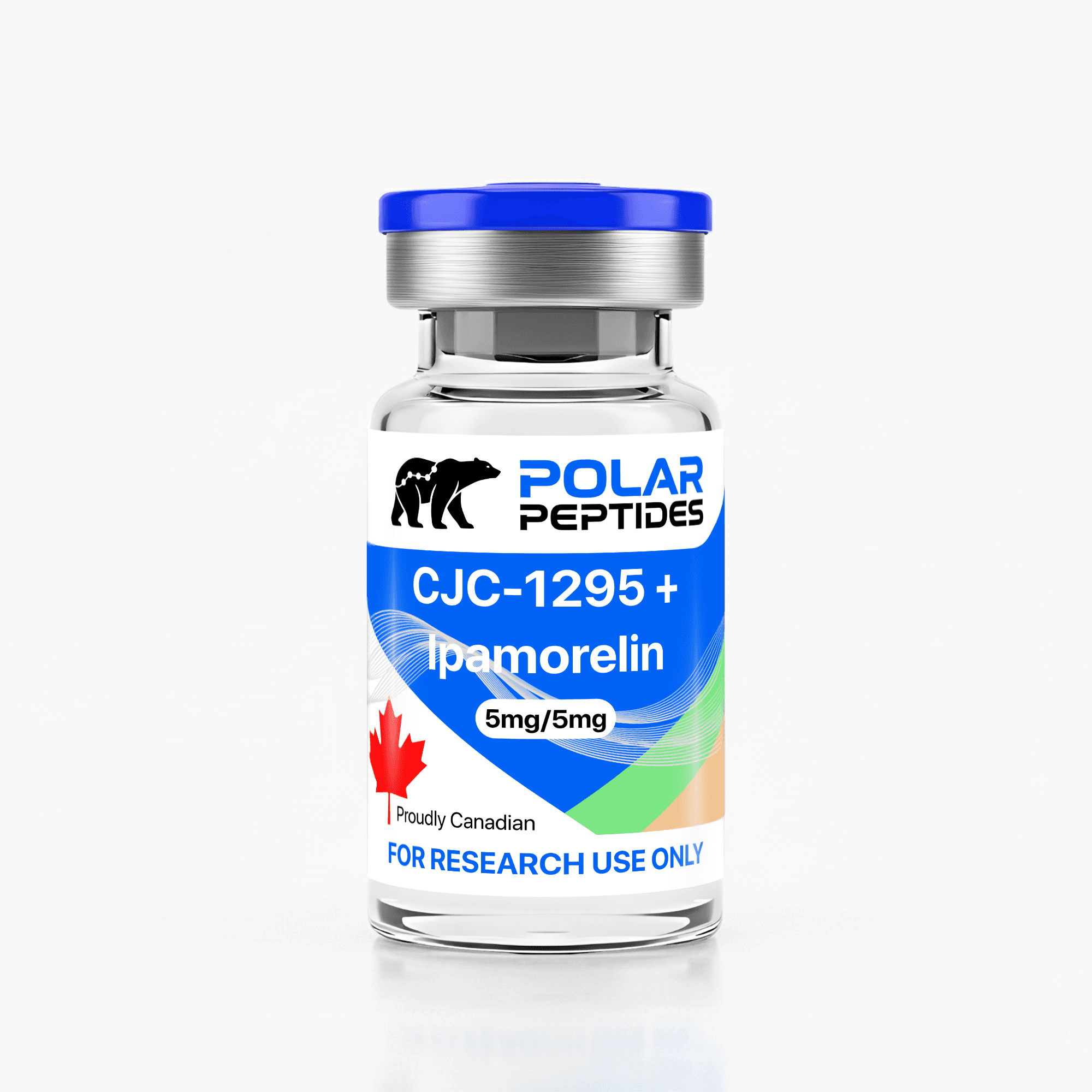
CJC-1295 + Ipamorelin
★★★★★4.9 — customer reviewsThe pairing of CJC-1295 (without DAC) and Ipamorelin is one of the most widely used research combinations for studying the pulsatile release of growth hormone with minimal impact on cortisol and prolactin.
- Purity
- 99%+
For laboratory research use only. Not for human consumption, medical or diagnostic use.
About CJC-1295 + Ipamorelin
CJC-1295 + Ipamorelin is a research combination (stack) of two synthetic peptides that act on the growth hormone system but through different receptors. CJC-1295 is an analogue of growth hormone-releasing hormone (GHRH), while Ipamorelin is a selective agonist of the ghrelin receptor (GHS-R1a), that is, a growth hormone secretagogue. This material is intended solely for laboratory research and is not a medicinal product.
How it works
The two peptides act on the pituitary gland through complementary pathways: CJC-1295 activates the GHRH receptor and prolongs the signal for growth hormone synthesis, while Ipamorelin activates the ghrelin receptor (GHS-R1a) and triggers a rapid, pulsatile release of already-stored growth hormone. In research, combining these mechanisms produces a stronger and more physiological (pulsatile) surge of growth hormone than either peptide alone. The rise in growth hormone, in turn, stimulates the production of IGF-1 in the liver — and it is through this cascade that most of the observed effects are realised.
What's studied / benefits
- Studies record a sustained, dose-dependent increase in growth hormone and IGF-1 levels (for example, in a paper published in the Journal of Clinical Endocrinology and Metabolism, 2006)
- Ipamorelin is regarded as a selective secretagogue: in models it has minimal impact on cortisol and prolactin levels compared with older GHRP peptides
- The combined stack reproduces the natural pulsatile pattern of growth hormone secretion thanks to simultaneous action on two different receptors
- In studies, the rise in IGF-1 becomes measurable after roughly 2–3 weeks, while changes in body composition in the models develop gradually over 8–12 weeks
- In a scientific context, the potential impact on muscle mass, fat metabolism, soft-tissue recovery and sleep quality is being studied
Research applications
- Research into the growth hormone – IGF-1 axis and the mechanisms of pulsatile growth hormone secretion
- Studying the synergy between a GHRH analogue and a ghrelin secretagogue (combined stimulation of two receptors)
- Preclinical body-composition models: the dynamics of muscle mass and adipose-tissue metabolism
- Research into tissue repair and the link between growth hormone secretion and phases of deep sleep
Of interest to: This combination is typically of interest to peptide researchers, laboratories studying the endocrine system and the growth hormone axis, as well as the sports and biohacking community that follows scientific data on growth hormone secretagogues.
- Class
- GHRH analogue (CJC-1295) + selective ghrelin receptor agonist / growth hormone secretagogue (Ipamorelin)
- CJC-1295 half-life
- without DAC (Mod GRF 1-29) — about 30 minutes; with DAC — approximately 6–8 days (covalent binding to albumin via Cys34)
- Targets
- CJC-1295 — the GHRH receptor; Ipamorelin — the ghrelin receptor GHS-R1a
- Status
- For laboratory research use only; not for medical use, not a medicinal product
This information is for educational purposes only and is not medical advice. CJC-1295 + Ipamorelin is intended for laboratory research use only — not for human consumption, medical or diagnostic use.