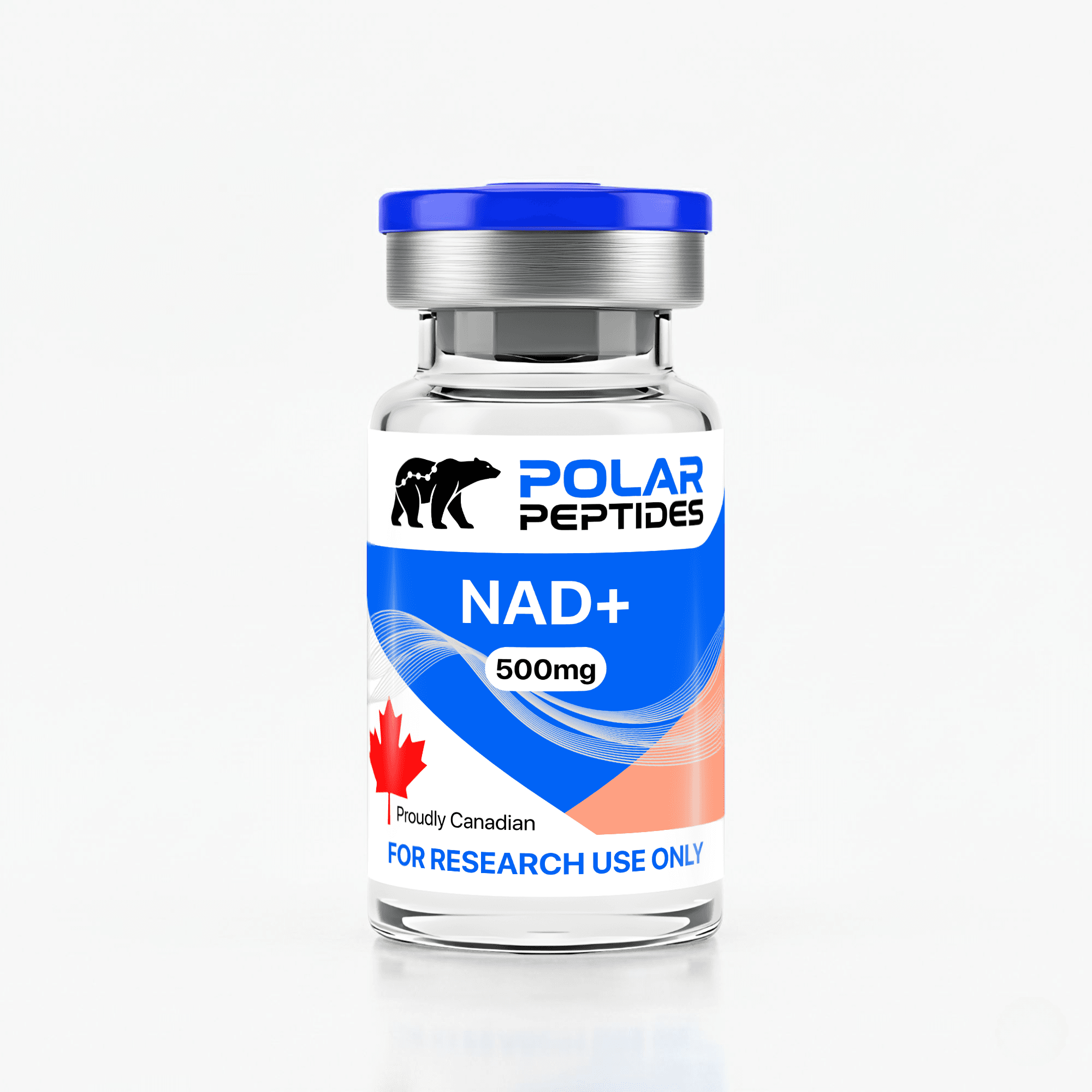
 99%+ purity
NAD+
★★★★★4.9 — customer reviewsNAD+ is a coenzyme involved in cellular energy metabolism and repair processes. It is one of the central subjects of longevity research.
- Purity
- 99%+
For laboratory research use only. Not for human consumption, medical or diagnostic use.
About NAD+
NAD+ (nicotinamide adenine dinucleotide) is not a peptide but a fundamental coenzyme present in every living cell and involved in hundreds of enzymatic reactions. It exists in two forms — oxidized (NAD+) and reduced (NADH) — which cycle back and forth, carrying electrons through the processes of cellular metabolism. In a research context, NAD+ is studied as a central regulator of energy metabolism, DNA repair and cellular aging.
How it works
NAD+ acts in two ways. First, as an electron carrier in the redox (oxidation–reduction) reactions of glycolysis, fatty-acid beta-oxidation and the Krebs cycle, supplying mitochondria with the substrate for ATP synthesis. Second, it serves as an obligatory substrate for NAD+-dependent enzymes — sirtuins (SIRT1–7), PARPs (DNA repair) and CD38 — which "consume" NAD+ while regulating gene expression, the DNA-damage response and cellular signaling. Intracellular NAD+ stores are replenished mainly through the salvage pathway involving the enzymes NAMPT and NMNAT, as well as from precursors — nicotinamide, NMN and NR.
What's studied / benefits
- Support for mitochondrial energy (ATP) production as a key electron carrier in cellular metabolism — according to preclinical research
- Activation of sirtuins — a family of enzymes that research links to DNA repair and the regulation of inflammation and metabolic homeostasis
- Enabling the function of PARP enzymes, which take part in recognizing and repairing DNA damage
- Research interest in neuroprotection: in experimental models of ischemia and glutamate excitotoxicity, NAD+ has been associated with reduced neuronal apoptosis and preserved mitochondrial function
- Compensating for the age-related decline in NAD+ levels, which research shows drops markedly with age — a topic studied in the context of metabolic and cardiovascular health
Research applications
- Studying the mechanisms of cellular aging and the age-related decline in NAD+ levels (longevity research)
- Research into energy metabolism, mitochondrial function and skeletal-muscle adaptation to exercise
- Preclinical models of neuroprotection and neurodegenerative conditions (ischemia/reperfusion, excitotoxicity)
- Research into cardiovascular and metabolic health, as well as the role of the NAD+/sirtuin/PARP/CD38 axis
Of interest to: The greatest interest in NAD+ comes from researchers in the fields of longevity and cellular metabolism, biohackers, as well as athletes and practitioners focused on recovery, energy metabolism and mental clarity.
- Compound class
- Coenzyme (dinucleotide), not a peptide; exists in the NAD+ / NADH forms
- Primary role
- Electron carrier in redox reactions + substrate for sirtuins, PARP and CD38
- Synthesis in the cell
- Salvage pathway (NAMPT → NMN → NMNAT → NAD+); precursors — nicotinamide, NMN, NR
- Storage
- Lyophilized powder at –20 °C or below (–80 °C for long-term storage); avoid moisture and repeated freeze–thaw cycles
This information is for educational purposes only and is not medical advice. NAD+ is intended for laboratory research use only — not for human consumption, medical or diagnostic use.