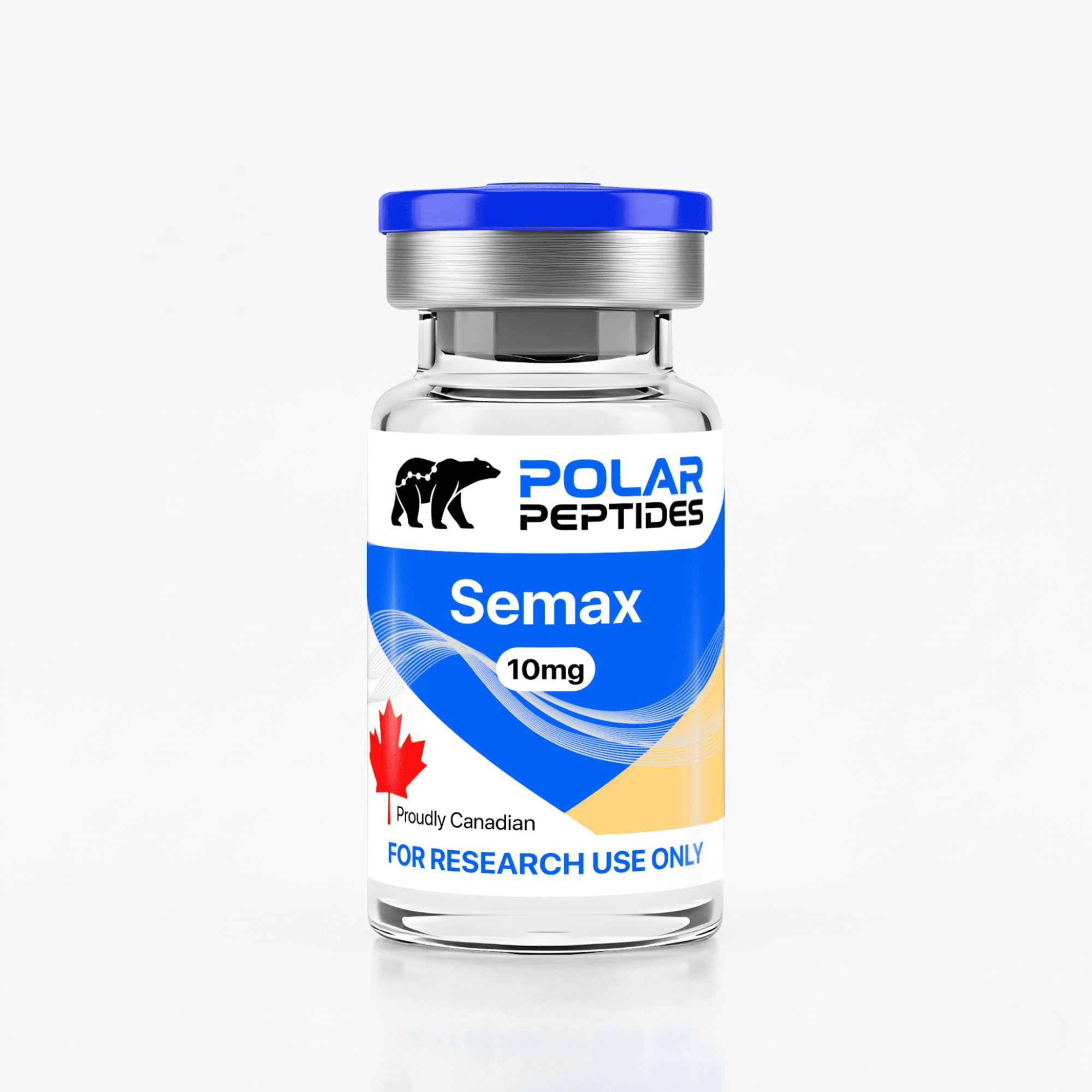
 99%+ purity
Semax
★★★★★4.9 — customer reviewsSemax is a synthetic peptide derived from ACTH. It is studied in the context of concentration, neuroprotection and stress resilience.
- Purity
- 99%+
For laboratory research use only. Not for human consumption, medical or diagnostic use.
About Semax
Semax is a synthetic heptapeptide, an analogue of fragment 4–10 of adrenocorticotropic hormone (ACTH) with an added Pro-Gly-Pro sequence. Attaching Pro-Gly-Pro to the C-terminus shields the molecule from rapid peptidase cleavage — the bare ACTH(4–10) fragment survives only seconds in plasma.
How it works
In research, the principal mechanism is thought to be increased expression of neurotrophic factors — chiefly BDNF (brain-derived neurotrophic factor) and NGF (nerve growth factor) — via CREB-dependent transcription and activation of TrkB receptors. This triggers intracellular cascades (MAPK/ERK, PI3K/Akt) linked to neuronal survival, synaptic plasticity and neurogenesis. Models additionally describe modulation of dopaminergic and serotonergic transmission, antioxidant and anti-inflammatory effects, while the Pro-Gly-Pro fragment slows enzymatic degradation, prolonging its action compared with the unmodified ACTH fragment.
What's studied / benefits
- In animal studies it raises levels of BDNF, NGF and GDNF in the hippocampus and cerebral cortex, which is associated with neuroplasticity and neurogenesis
- Demonstrates neuroprotective properties in models of cerebral ischaemia — reducing neuronal damage from oxidative stress and apoptosis
- In preclinical models of chronic stress it prevents the decline in BDNF expression and the development of depression-like behaviour
- In observational clinical data it is associated with improved attention and short-term memory and with EEG changes indicating enhanced cortical information processing
- Modulates the expression of genes involved in the inflammatory response, stress reaction and cellular repair
Research applications
- Studied as a neuroprotectant in models of ischaemic stroke and cerebral ischaemia-reperfusion
- Investigated as a nootropic — its effect on attention, information-processing speed, learning and memory
- Its role in the expression of neurotrophins (BDNF, NGF) and in supporting neurogenesis is being studied
- Considered in the context of oxidative stress and potential applications in neurodegenerative processes (models of Alzheimer's and Parkinson's disease)
Of interest to: It typically appeals to researchers in neuroscience and pharmacology, as well as biohackers and enthusiasts of cognitive compounds who study nootropic and neuroprotective peptides.
- Class
- Synthetic heptapeptide, an analogue of ACTH(4–10) with a Pro-Gly-Pro fragment
- Plasma half-life
- approximately 2–5 minutes (rapid enzymatic degradation)
- Sequence
- Met-Glu-His-Phe-Pro-Gly-Pro — the ACTH(4–7) fragment with an added Pro-Gly-Pro
- Storage
- lyophilised powder — in a freezer; the reconstituted solution — in a refrigerator, to be used within a few weeks
This information is for educational purposes only and is not medical advice. Semax is intended for laboratory research use only — not for human consumption, medical or diagnostic use.